Why Do People Use RFID Blocking Products?
Contactless technologies such as RFID and NFC are now embedded in credit cards, debit cards, ID cards, and passports. While these technologies enable fast, convenient transactions, they have also raised concerns about unauthorized RFID scanning, often referred to as RFID skimming.
RFID blocking products are designed to reduce this risk by preventing electromagnetic signals from reaching the chip inside a card. The two most common consumer solutions are RFID blocking cards and RFID blocking sleeves. Although they aim to solve the same problem, they work in different ways and are suited to different usage scenarios.
What Is an RFID Blocking Card?
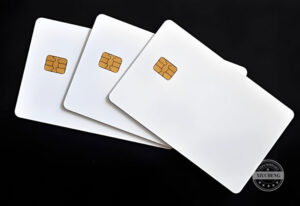
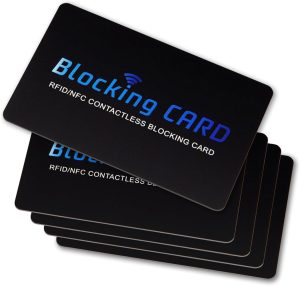
An RFID blocking card is a rigid card, typically the same size as a credit card, that you place inside your wallet alongside your contactless cards.
How RFID Blocking Cards Work
Most RFID blocking cards function in one of two ways:
- Passive shielding:
The card contains metallic or conductive layers that absorb or disrupt RFID/NFC signals. - Signal interference (resonance-based):
Some designs interfere with the reader’s field, making it difficult for nearby cards to be energized and read.
Rather than enclosing a single card, an RFID blocking card is intended to protect multiple cards at once, depending on wallet layout and distance.
Key Characteristics
- Protects several cards simultaneously
- No need to remove cards during daily use
- Durable and reusable
- Effectiveness depends on wallet structure and placement
What Is an RFID Blocking Sleeve?
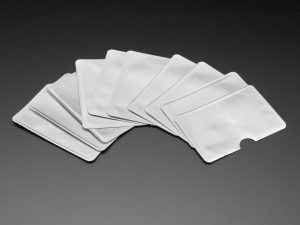
An RFID blocking sleeve is a thin pouch—usually made of metallized paper, aluminum composite, or conductive fabric—designed to hold one card at a time.
How RFID Blocking Sleeves Work
RFID sleeves create a Faraday cage effect. When the card is fully enclosed, the conductive material blocks electromagnetic fields from reaching the RFID chip.
As long as the card remains inside the sleeve, it cannot be read by an RFID or NFC reader.
Key Characteristics
- Protects one specific card
- Requires removing the card before use
- Lightweight and low-cost
- May wear out over time due to friction and bending
RFID Blocking Cards vs RFID Blocking Sleeves: A Direct Comparison
| Aspect | RFID Blocking Card | RFID Blocking Sleeve |
|---|---|---|
| Protection method | Interference or partial shielding | Full enclosure (Faraday cage) |
| Cards protected | Multiple cards | One card |
| Ease of use | Very high | Moderate |
| Durability | High | Medium to low |
| Consistency | Placement-dependent | Highly consistent |
| Best for | Everyday wallets | Passports, travel cards |
Which Option Is More Effective?
Effectiveness depends on how the product is used, not just the product itself.
- RFID sleeves provide more predictable protection because the card is fully enclosed.
- RFID blocking cards are more convenient, but their performance can vary depending on wallet thickness, card orientation, and distance between cards.
In real-world scenarios, both solutions are generally sufficient to block low-power, short-range NFC skimming, which is the most common concern.
When Should You Use an RFID Blocking Card?
RFID blocking cards are ideal if:
- You carry multiple contactless cards daily
- You want a “set it and forget it” solution
- Convenience matters more than isolating individual cards
They are commonly used in minimalist wallets or cardholders where space is limited.
When Are RFID Blocking Sleeves a Better Choice?
RFID blocking sleeves are better suited for:
- Passports and national ID cards
- Travel scenarios (airports, hotels, public transport)
- Cards that are rarely used but highly sensitive
Many travelers prefer sleeves because they offer dedicated, document-level protection.
Do You Actually Need RFID Blocking Products?
For most consumers, the risk of real-world RFID skimming is low but not zero. Modern payment systems also include encryption, short read ranges, and transaction limits.
RFID blocking products should be viewed as a preventive privacy measure, not a replacement for secure payment systems or responsible card management.
Final Thoughts
RFID blocking cards and RFID blocking sleeves are not competitors—they are tools designed for different behaviors and risk profiles.
- Choose RFID blocking cards for daily convenience and multi-card coverage
- Choose RFID blocking sleeves for maximum isolation and travel security
Understanding how each solution works allows you to select the option that best fits your lifestyle and usage habits—rather than relying on marketing claims alone.
You might like: What Materials Can Block RFID Signals?