


Radio Frequency Identification (RFID) technology has evolved rapidly over the past two decades. While early RFID tags were relatively large and bulky, modern manufacturing techniques have enabled extremely small RFID tags, some even smaller than a grain of rice.
But how small can RFID tags really be? And what factors determine their minimum size?
In this article, we explore the smallest RFID tags available today, the technical constraints behind their size, and where these miniature RFID devices are used in real-world applications.
The Basic Components of an RFID Tag
To understand size limitations, it’s important to know what an RFID tag contains. A typical passive RFID tag consists of three core components:
1. Microchip (IC)
The integrated circuit stores data such as the tag’s unique ID and handles communication with RFID readers.
2. Antenna
The antenna receives radio signals from the reader and powers the chip in passive RFID systems.
3. Substrate or Encapsulation
The chip and antenna are mounted on a material such as plastic, PET, paper, or glass to protect the electronics.
Among these components, the antenna usually determines the overall tag size, because it must be large enough to capture energy from the RFID reader.
The Smallest RFID Chips Ever Produced
Semiconductor manufacturers have achieved remarkable miniaturization.
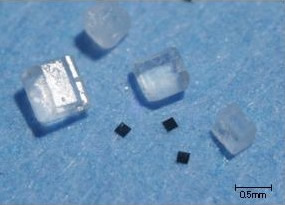
One of the most well-known examples is the Hitachi ultra-small RFID chip, which measures approximately:
- 0.15 mm × 0.15 mm
This chip is so small it can be embedded into paper, labels, or even banknotes.
However, the chip itself is only one part of the RFID system. When integrated with an antenna and packaging, the final RFID tag becomes larger.
Typical Sizes of Commercial RFID Tags
In real-world products, RFID tags are generally larger than the microchip itself.
UHF RFID Labels
Commonly used in logistics and retail.
Typical sizes:
- 73 × 21 mm
- 95 × 10 mm
- 44 × 19 mm
These sizes allow the antenna to achieve long read ranges of several meters.
NFC / HF RFID Tags
Often used in contactless payments and smartphones.
Typical sizes:
- 25 mm round
- 30 × 30 mm
- 40 × 40 mm
Smaller antennas reduce read range but are still usable for smartphone interaction.
Micro RFID Tags
Specialized tags designed for very small objects.
Examples include:
- 3 × 3 mm
- 5 × 5 mm
- 6 × 2 mm
These miniature tags are commonly used for:
- jewelry tracking
- medical device identification
- tool management
- small electronics
Glass Implantable RFID Microchips
One of the smallest complete RFID tags used in practice is the implantable glass RFID microchip used for animal identification.
Typical size:
- 2.12 mm × 12 mm
These tags are injected under the skin of pets or livestock using a syringe and can be scanned with handheld RFID readers.
They contain:
- a tiny RFID chip
- a miniature coil antenna
- a biocompatible glass capsule
Despite their small size, they remain readable for many years.
What Limits the Size of RFID Tags?
Several physical and engineering factors limit how small RFID tags can become.
1. Antenna Size
The antenna must capture enough electromagnetic energy to power the chip in passive RFID systems.
If the antenna becomes too small:
- signal strength decreases
- read range becomes extremely short
- reliability drops
This is the primary limitation of RFID miniaturization.
2. Operating Frequency
Different RFID frequencies require different antenna sizes.
Low-frequency RFID (LF, 125–134.2 kHz) usually requires larger coil antennas.
High-frequency (HF / NFC 13.56 MHz) tags can be smaller.
Ultra-high frequency (UHF) tags often require longer antennas for optimal range.
3. Manufacturing Constraints
Handling extremely small components creates production challenges:
- chip bonding precision
- antenna alignment
- durability and protection
As tags shrink, manufacturing costs often increase.
Emerging Ultra-Miniature RFID Technologies
Researchers are continually pushing the limits of RFID miniaturization.
Some experimental tags are:
- smaller than 1 mm²
- embedded directly into materials
- printed using flexible electronics
Future innovations may allow RFID tags to be integrated into:
- pharmaceutical tablets
- medical implants
- high-security documents
- smart packaging
These developments are expanding the possibilities for Internet of Things (IoT) applications.
Real-World Applications of Small RFID Tags
Miniature RFID tags are already used in many industries.
Healthcare
RFID microtags help track:
- surgical instruments
- medical devices
- pharmaceuticals
Jewelry Industry
Tiny RFID tags are used to identify:
- diamonds
- watches
- luxury accessories
Electronics Manufacturing
Manufacturers use small RFID tags to track:
- circuit boards
- components
- repair history
Livestock Identification
Implantable RFID microchips help identify animals such as:
- dogs
- cats
- cattle
- sheep
These tags enable permanent electronic identification.
Choosing the Right RFID Tag Size
Selecting an RFID tag involves balancing several factors:
- required read range
- available installation space
- environmental conditions
- cost considerations
In general:
- smaller tags = shorter read range
- larger antennas = better performance
This trade-off is fundamental in RFID design.
Custom Miniature RFID Tags from XIUCHENG RFID
XIUCHENG RFID specializes in designing and manufacturing custom RFID tags for diverse industrial applications.
Our product range includes:
- ultra-small RFID labels
- NFC mini tags
- glass implantable animal microchips
- durable RFID tags for harsh environments
With advanced chip integration and antenna design capabilities, we help customers create RFID solutions tailored to size constraints and performance requirements.


