In bird management—whether in poultry farming, pigeon racing, or breeding—identification has traditionally relied on visual tags and manual records. This approach is time-consuming, error-prone, and difficult to scale.
RFID bird rings solve this by assigning each bird a unique digital identity. The real value, however, is not the tag itself, but how it performs in actual working environments. Below are the most common high-value applications, explained from an operational and commercial perspective.
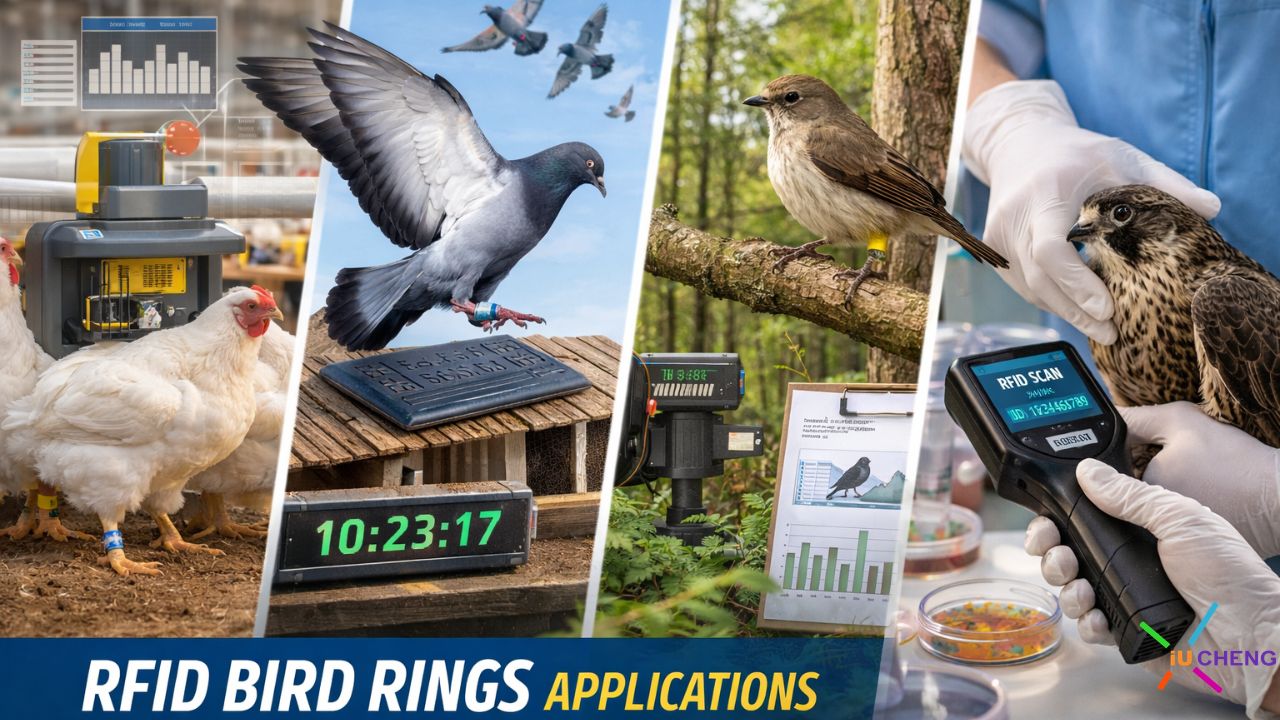
Poultry Farming: Turning Daily Operations Into Data
On a typical poultry farm, thousands of birds are managed in batches rather than individually. This limits visibility and makes it difficult to detect problems early.
After deploying RFID bird rings:
- Each bird is uniquely identified
- Fixed readers are installed at feeding and movement points
- Data is collected automatically without manual input
In practice, this allows farm managers to see:
- Which birds are not feeding normally
- Movement patterns across different zones
- Early signs of illness or stress
The impact is straightforward: fewer losses, better feed efficiency, and reduced reliance on manual labor. For farms operating at scale, even small improvements translate into measurable cost savings.
Racing Pigeons: Accuracy Becomes the Standard
Timing is everything in pigeon racing. Manual recording introduces delays and inconsistencies, especially in competitive environments.
With RFID:
- Each pigeon carries a ring linked to its identity
- A reader installed at the loft entrance captures arrival time instantly
- Data is recorded automatically and cannot be altered
This removes disputes and ensures consistency across events. Clubs that adopt RFID systems typically standardize their operations quickly, because the benefits are immediate and visible.
Breeding Operations: Managing High-Value Birds
In breeding environments, especially with rare or high-value birds, identification is tied directly to economic value.
RFID bird rings make it possible to:
- Track lineage accurately
- Link each bird to medical and breeding records
- Verify ownership without relying on paperwork
Instead of checking physical tags or documents, a handheld reader provides instant access to all relevant data. This reduces errors in breeding programs and protects the value of each bird.
Wildlife Research: Long-Term Monitoring Without Disturbance
For researchers, minimizing human interference is essential. Traditional tagging methods require repeated handling, which can affect behavior.
RFID bird rings allow passive monitoring:
- Birds are tagged once
- Readers are placed near nests or feeding areas
- Data is collected automatically over time
Researchers can then analyze:
- Migration timing
- Habitat usage
- Survival rates
The advantage is continuity—data can be collected over long periods without disrupting natural behavior.
Disease Control: Faster Response, Lower Risk
In large bird populations, disease spreads quickly and is often difficult to trace.
RFID systems provide movement data:
- Which birds were in the same area
- When contact occurred
- How activity patterns changed over time
When an issue is detected, affected groups can be isolated more precisely. This reduces the scale of outbreaks and limits economic damage.
Smart Feeding Systems: Moving Toward Precision Management
Some operations are beginning to combine RFID with automated feeding systems.
In this setup:
- A feeding station identifies each bird via RFID
- Consumption and visit frequency are recorded
- Abnormal patterns are flagged
Over time, this creates a behavioral profile for each bird. Managers can adjust feeding strategies or intervene early when something changes.
This is where RFID starts to move beyond identification and becomes part of a broader data system.
Choosing the Right Configuration
Different use cases require different technical setups:
- Short-range, stable environments typically use low-frequency systems
- Applications requiring faster or bulk reading rely on UHF
- Lightweight, flexible deployments often use HF/NFC
Other factors such as ring size, material durability, and chip quality should match the specific bird type and environment.

About XIUCHENG RFID
XIUCHENG RFID specializes in manufacturing a wide range of RFID products, including RFID Silicone Wristbands, Tyvek Wristbands, Fabric Wristbands, Elastic Wristbands, Vinyl Wristbands, RFID Laundry Tags, Animal Tags, and RFID Cards. All products are produced under strict quality control and advanced production technology.
With 12 years of experience in wristband design, tag design, quality management, and customer relationship management, we have built a solid foundation for delivering reliable and high-performance RFID solutions.
Conclusion
RFID bird rings are not a theoretical upgrade. They address practical problems: identification, tracking, and data accuracy.
In environments where scale, precision, or traceability matter, they quickly become part of the core infrastructure.
The main question is no longer whether to use RFID, but how to implement it in a way that fits the operation.