


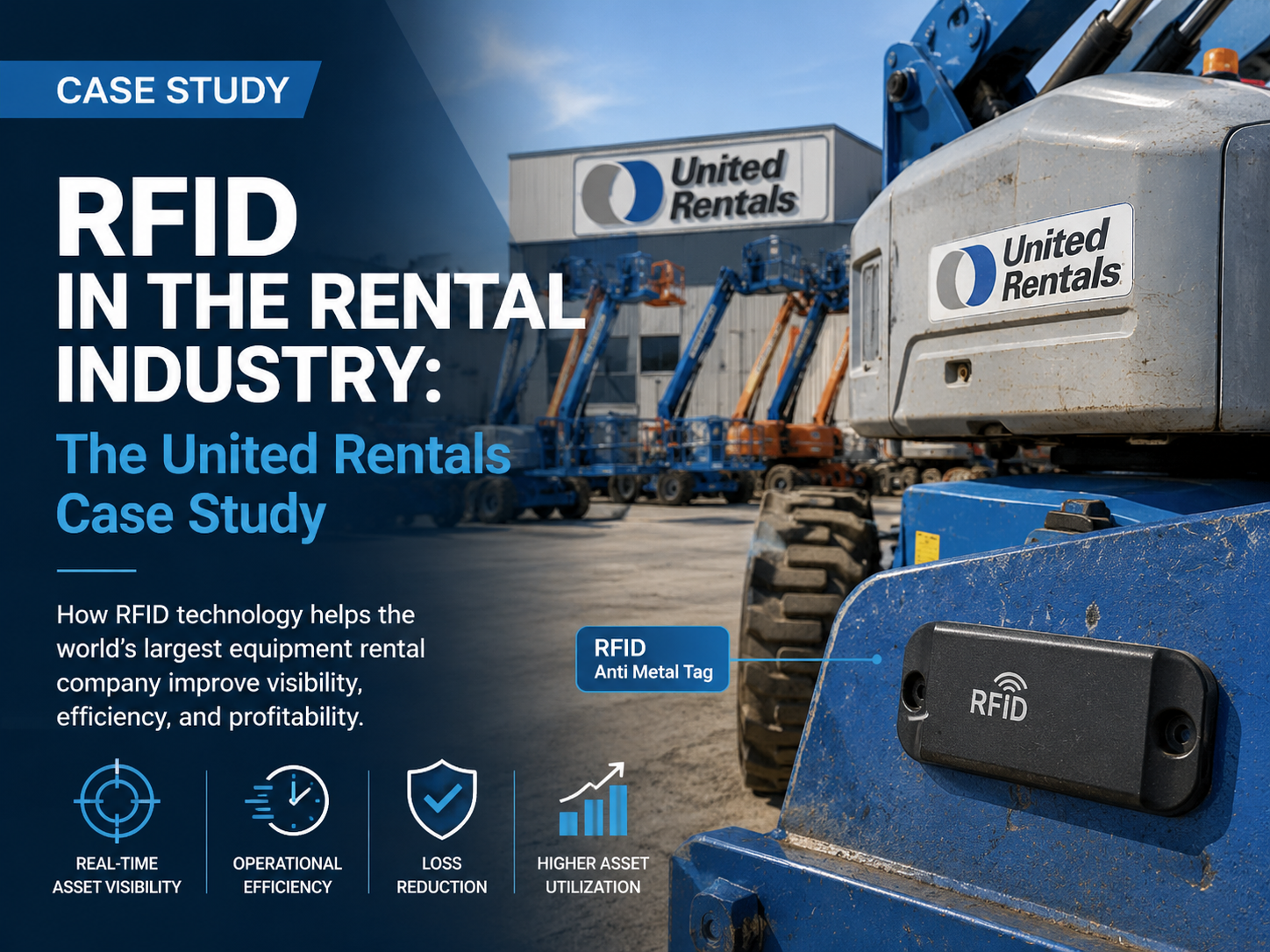
The global rental industry is built on one core principle: asset utilization.
For companies managing thousands of generators, excavators, forklifts, aerial lifts, and construction tools across multiple locations, knowing exactly where every asset is — and whether it is available, rented, idle, or under maintenance — directly impacts profitability.
This is why many leading rental companies have invested heavily in RFID and IoT asset tracking technologies.
Among them, United Rentals stands out as one of the most influential examples of digital transformation in equipment rental management.
Official website: United Rentals
About United Rentals
Founded in 1997, United Rentals is the largest equipment rental company in the world.
The company operates:
- Thousands of rental locations
- Massive fleets of construction equipment
- Industrial tools
- Power and HVAC systems
- Mobile storage solutions
- Safety equipment
Its customers include:
- Construction firms
- Industrial plants
- Infrastructure contractors
- Government projects
- Event companies
- Oil & gas operators
Managing such a large rental fleet creates enormous operational complexity.
The Core Challenge in Equipment Rental
Traditional rental operations often struggle with:
| Operational Problem | Business Impact |
|---|---|
| Lost equipment | High replacement costs |
| Manual inventory counting | Labor-intensive operations |
| Unknown asset location | Reduced utilization |
| Delayed maintenance | Increased downtime |
| Incorrect rental records | Billing disputes |
| Idle assets | Lower ROI |
| Cross-branch transfers | Poor visibility |
In large-scale rental environments, even a single misplaced machine can cost thousands of dollars per day.
For this reason, RFID became a highly practical solution.
Why RFID Fits the Rental Industry Perfectly
RFID technology enables:
- Fast identification
- Bulk asset scanning
- Automated check-in/check-out
- Real-time tracking
- Lifecycle monitoring
Unlike barcodes, RFID tags do not require direct line-of-sight scanning.
This is especially important for:
- Dirty construction sites
- Outdoor environments
- Heavy equipment yards
- Fast-moving logistics operations
How RFID Is Used in Equipment Rental Operations
1. Equipment Identification
Each rental asset receives a unique RFID identifier.
Typical tagged assets include:
- Excavators
- Generators
- Forklifts
- Compressors
- Welding machines
- Power tools
- Lighting towers
Most rental companies use:
- UHF RFID hard tags
- Metal-mount RFID tags
- Rugged industrial RFID labels
These tags are designed to survive:
- Rain
- Dust
- Vibration
- Heat
- Outdoor UV exposure
2. Automated Yard Management
One of the biggest challenges for rental companies is yard visibility.
RFID readers installed at:
- Warehouse gates
- Yard entrances
- Loading docks
- Service areas
can automatically detect equipment movement.
Benefits include:
- Faster dispatch
- Reduced search time
- Automatic inventory updates
- Improved logistics coordination
Instead of manually searching for equipment, staff can instantly identify asset locations.
3. Rental Check-In and Check-Out Automation
Traditional rental workflows often involve:
- Paper forms
- Manual serial number recording
- Barcode scanning
- Human verification
RFID simplifies the process dramatically.
When equipment passes through an RFID gate:
- The system automatically records departure
- Rental status updates instantly
- Customer assignment is logged
- Return timestamps are captured automatically
This reduces:
- Human error
- Administrative workload
- Rental disputes
4. Preventive Maintenance Tracking
Rental equipment requires regular maintenance based on:
- Usage hours
- Rental cycles
- Time intervals
RFID helps maintenance teams:
- Identify assets instantly
- Access service history
- Track maintenance schedules
- Monitor equipment lifecycle
For large rental fleets, predictive maintenance can significantly reduce downtime.
5. Asset Utilization Optimization
In the rental business, idle assets reduce profitability.
RFID-based asset visibility allows companies to:
- Identify underutilized equipment
- Reallocate inventory between branches
- Improve fleet rotation
- Reduce unnecessary purchases
This directly improves ROI on rental equipment investments.
RFID + IoT: The Next Stage of Rental Intelligence
Many large rental companies now combine RFID with:
- GPS
- Telematics
- BLE
- IoT sensors
- Cloud platforms
This creates intelligent rental ecosystems capable of:
- Real-time tracking
- Usage monitoring
- Fuel management
- Remote diagnostics
- Theft prevention
In many cases, RFID serves as the foundational identification layer inside larger IoT asset management systems.
What Type of RFID Tags Are Used in Rental Equipment?

Metal-Mount RFID Tags
Most construction equipment contains metal surfaces.
Therefore, rental companies commonly use:
- On-metal RFID tags
- Rugged ABS RFID tags
- Ceramic anti-metal tags
These tags are optimized for:
- Harsh industrial environments
- Long read distances
- Durable outdoor usage
Typical RFID Infrastructure in Rental Companies
| RFID Component | Purpose |
|---|---|
| RFID hard tags | Asset identification |
| Handheld RFID readers | Mobile inventory scanning |
| Fixed RFID readers | Gate monitoring |
| RFID antennas | Zone coverage |
| Asset management software | Data visualization |
| Cloud platform | Fleet monitoring |

About XIUCHENG RFID
XIUCHENG RFID specializes in manufacturing a wide range of RFID products, including RFID Silicone Wristbands, Tyvek Wristbands, Fabric Wristbands, Elastic Wristbands, Vinyl Wristbands, RFID Laundry Tags, Animal Tags, and RFID Cards. All products are produced under strict quality control and advanced production technology.
With 12 years of experience in wristband design, tag design, quality management, and customer relationship management, we have built a solid foundation for delivering reliable and high-performance RFID solutions.
Business Benefits of RFID in Rental Operations
Companies like United Rentals can achieve substantial operational improvements through RFID-enabled asset tracking.
Potential benefits include:
| Benefit | Operational Impact |
|---|---|
| Faster inventory counting | Reduced labor costs |
| Improved asset visibility | Higher utilization |
| Reduced equipment loss | Lower replacement costs |
| Automated workflows | Faster operations |
| Better maintenance control | Reduced downtime |
| Accurate billing | Fewer disputes |
| Real-time data | Better decision-making |
Why RFID Adoption Is Growing in the Rental Industry
Several global trends are accelerating RFID adoption:
1. Labor Shortages
Rental companies need automation to reduce manual work.
2. Fleet Expansion
Larger fleets become impossible to manage manually.
3. Digital Transformation
Rental companies are moving toward smart asset ecosystems.
4. IoT Integration
RFID provides a cost-effective identification layer for connected equipment.
5. Rising Equipment Costs
Tracking and protecting assets becomes more important as equipment prices increase.
RFID Products Commonly Used in Rental Applications
RFID manufacturers supplying rental companies often provide:
| Product Type | Application |
|---|---|
| UHF hard tags | Heavy equipment |
| Anti-metal RFID tags | Construction machinery |
| ABS RFID tags | Tool tracking |
| RFID cable seals | Rental containers |
| RFID labels | Small tools |
| Handheld readers | Inventory management |
Final Thoughts
The rental industry is rapidly evolving from manual asset management toward intelligent, automated operations.
Companies like United Rentals demonstrate how RFID can improve:
- Asset visibility
- Operational efficiency
- Equipment utilization
- Maintenance management
- Fleet scalability
As the global rental economy continues expanding, RFID will likely become a standard infrastructure technology rather than an optional upgrade.
For RFID manufacturers, system integrators, and industrial solution providers, the rental industry represents one of the most valuable long-term growth markets for RFID deployment.


