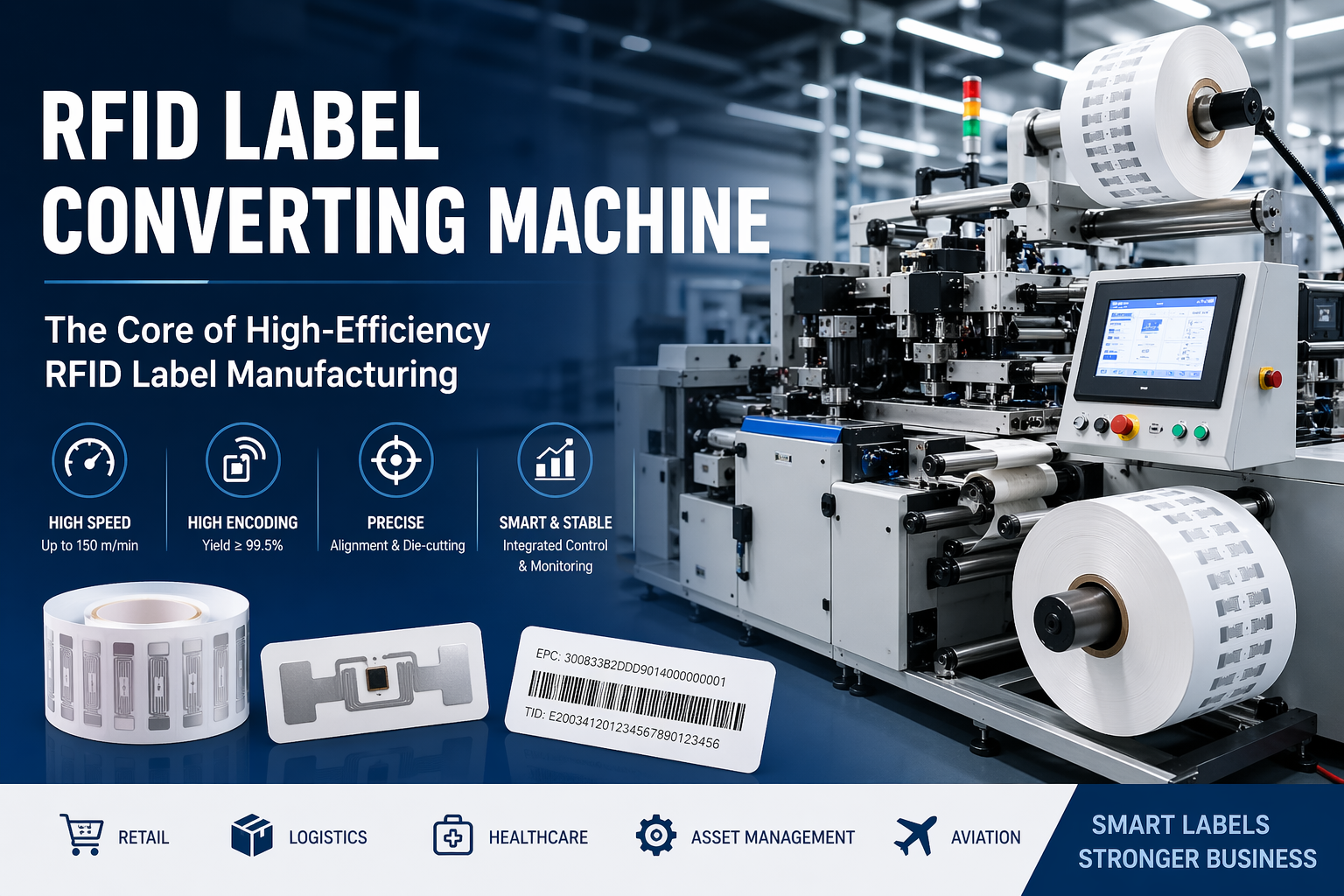
In the RFID industry, production efficiency is not defined by chip performance alone—it is determined by how precisely and consistently RFID labels can be converted at scale. For any RFID label manufacturing factory, the RFID label converting machine is the core asset that bridges raw RFID inlays with finished, application-ready smart labels.
What Is an RFID Label Converting Machine?
An RFID label converting machine is an integrated industrial system designed to process RFID inlays (dry or wet) into finished labels through a sequence of converting operations. These operations typically include:
- Unwinding RFID inlay rolls
- Printing (optional variable or static data)
- Lamination and adhesive bonding
- Die-cutting into label shapes
- RFID encoding and verification
- Waste matrix removal
- Rewinding finished labels
Unlike standard label converting equipment, RFID converting machines must handle sensitive IC chips and antennas, requiring precise tension control, alignment accuracy, and integrated RFID testing systems.
Core Modules and Machine Architecture
From an engineering standpoint, a high-performance RFID label converting machine is modular. Each module serves a specific role in ensuring throughput, yield, and encoding accuracy.
1. Unwinding and Web Handling System
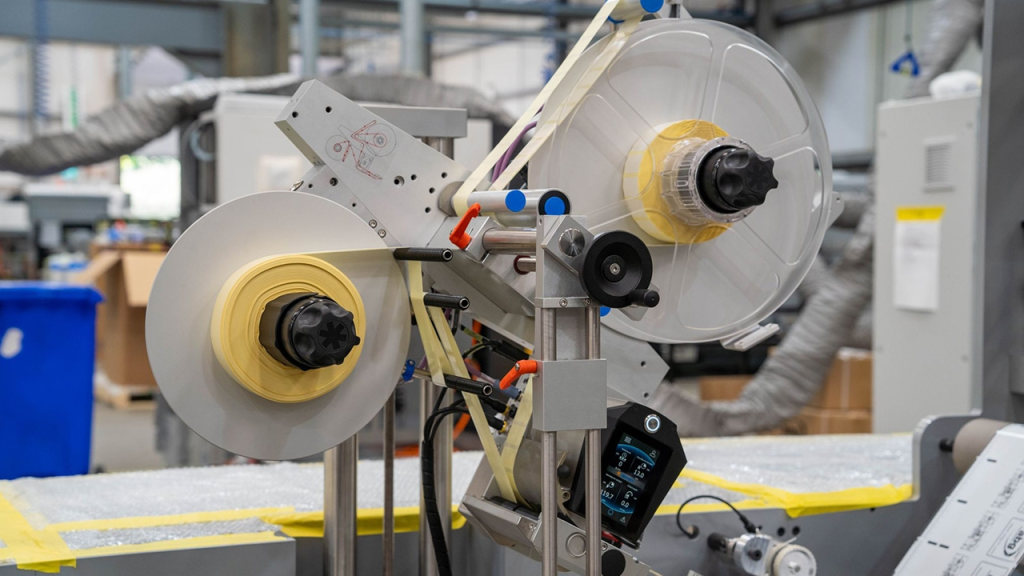
This module feeds RFID inlays into the production line. Advanced systems include:
- Automatic tension control (closed-loop servo systems)
- Edge guiding for web alignment
- Splice tables for continuous roll change
Precision at this stage is critical. Any deviation can result in chip damage or misalignment in downstream processes.
2. RFID Encoding and Verification Unit
This is the most distinctive component of an RFID converting machine.
Key functions:
- Encoding EPC, UID, or custom data into RFID chips
- Real-time verification of chip readability
- Rejecting defective inlays automatically
Industrial-grade machines support multiple protocols:
- UHF (EPC Gen2 / ISO 18000-6C)
- HF / NFC (ISO 14443, ISO 15693)
Encoding speed can reach 20,000–50,000 tags per hour depending on chip type and configuration.
3. Printing System (Optional but Critical)
For retail, logistics, and asset tracking applications, visual data must align with RFID data.
Printing options include:
- Flexographic printing (high-speed, bulk production)
- Thermal transfer printing (variable data, barcodes)
- Inkjet printing (high-resolution serialization)
Integration between printing and encoding ensures data consistency—critical for traceability systems.
4. Lamination and Adhesive Application
RFID labels often require multilayer structures:
- Face stock (paper, PET, PP)
- RFID inlay
- Adhesive layer
- Release liner
The lamination unit bonds these layers with controlled pressure and temperature. Poor lamination leads to delamination or reduced tag durability.
5. Die-Cutting System
Rotary die-cutting is used to shape labels into final formats.
Technical considerations:
- Die-cut accuracy tolerance: typically ±0.1 mm
- Avoiding antenna damage during cutting
- Custom tooling for different label shapes
Magnetic cylinders or flexible dies are commonly used for quick changeovers.
6. Waste Removal and Rewinding
After die-cutting:
- Matrix waste is stripped automatically
- Finished labels are rewound into rolls
High-end systems include automatic inspection cameras to detect defects before rewinding.
Production Workflow: Step-by-Step
From a factory perspective, the RFID label converting process follows a tightly controlled sequence:
- Load RFID inlay rolls (dry or wet)
- Align web and stabilize tension
- Encode RFID chips with required data
- Verify chip functionality and filter defective units
- Print visual identifiers (if required)
- Laminate face material and adhesive
- Die-cut labels into final shapes
- Remove waste matrix
- Rewind finished labels for packaging
Each step is synchronized through a central PLC system to maintain throughput and minimize downtime.
Key Technical Parameters Buyers Care About
When sourcing an RFID label converting machine, procurement managers and production engineers typically evaluate the following specifications:
Production Speed
- Standard range: 30–120 meters per minute
- High-speed systems: up to 150 m/min (depending on encoding complexity)
Encoding Yield Rate
- Target: ≥99.5%
- Influenced by chip quality, antenna design, and RF environment
Web Width Compatibility
- Common widths: 100 mm to 350 mm
- Wider webs increase throughput but require more precise control
Supported Inlay Types
- Dry inlay
- Wet inlay
- On-metal RFID labels (special configuration)
Automation Level
- Semi-automatic vs fully automatic
- Auto splicing, defect marking, and rejection systems
Applications Across Industries
RFID label converting machines are deployed in multiple high-growth sectors:
Retail and Apparel
- Item-level tagging
- Inventory accuracy improvement
- Omni-channel fulfillment
Logistics and Warehousing
- Pallet and carton tracking
- Real-time inventory visibility
Healthcare
- Pharmaceutical tracking
- Medical asset management
Asset Management and Industrial IoT
- Equipment tracking
- Tool management
Aviation and Baggage Handling
- RFID baggage tags for airports
Each application imposes different requirements on label durability, encoding standards, and production volumes.
Common Challenges in RFID Label Converting
Even with advanced machinery, manufacturers face several technical challenges:
Chip Sensitivity
RFID ICs are vulnerable to electrostatic discharge (ESD) and mechanical stress. Machines must include:
- ESD protection systems
- Soft nip rollers and controlled pressure zones
Encoding Failure Rates
Poor RF shielding or interference can reduce encoding success rates. Proper antenna calibration is essential.
Material Compatibility
Different face stocks and adhesives behave differently under heat and pressure, requiring process optimization.
Alignment Accuracy
Misalignment between printed data and RFID encoding can cause downstream scanning errors.
How to Choose the Right RFID Label Converting Machine
From a factory procurement perspective, selection should be based on:
Production Volume
- High-volume factories need fully automated, high-speed systems
- Smaller operations may prefer modular or semi-automatic machines
Application Requirements
- Retail vs industrial vs on-metal labels
- UHF vs NFC production
Integration Capabilities
- ERP/MES system integration
- Data serialization and cloud connectivity
Supplier Expertise
Choose a manufacturer with proven RFID domain knowledge—not just general label converting experience.
Future Trends in RFID Converting Technology
The next generation of RFID label converting machines is evolving toward:
- Inline inspection with AI-based defect detection
- Digital twin monitoring for predictive maintenance
- Higher encoding speeds for mass retail adoption
- Integration with IoT platforms for real-time production analytics
As RFID adoption accelerates globally, converting machines are becoming smarter, faster, and more data-driven.
Final Thoughts
For any RFID label manufacturing factory, the converting machine is not just a piece of equipment—it is the backbone of scalable production. Precision in encoding, consistency in material handling, and integration across modules determine whether a production line can meet the demands of modern RFID deployments.
Investing in the right RFID label converting machine directly impacts product quality, operational efficiency, and ultimately, your competitiveness in the global RFID market.

About XIUCHENG RFID
XIUCHENG RFID specializes in manufacturing a wide range of RFID products, including RFID Silicone Wristbands, Tyvek Wristbands, Fabric Wristbands, Elastic Wristbands, Vinyl Wristbands, RFID Laundry Tags, Animal Tags, and RFID Cards. All products are produced under strict quality control and advanced production technology.
With 12 years of experience in wristband design, tag design, quality management, and customer relationship management, we have built a solid foundation for delivering reliable and high-performance RFID solutions.