RFID microchips for dogs have become the global standard for permanent pet identification. Unlike collars or tags that can fall off or be removed, an RFID dog microchip provides a lifelong, tamper-resistant identity that links a dog to its owner through a secure database.
But how does a dog microchip actually work? What RFID technology is used? And what happens when a lost dog is scanned?
This article explains the real technical mechanism behind RFID dog microchips, cutting through common myths and marketing oversimplifications.
What Is an RFID Microchip for Dogs?
A dog RFID microchip is a passive low-frequency (LF) RFID transponder, typically operating at 134.2 kHz, implanted subcutaneously—usually between the shoulder blades.
It consists of:
- An RFID integrated circuit (IC)
- A copper antenna coil
- A biocompatible glass capsule
- Anti-migration coating (often parylene)
There is no battery, no GPS, and no active transmission.
From a technology standpoint, dog microchips are ISO-standard animal identification transponders, not consumer NFC or UHF RFID tags.
RFID Standards Used in Dog Microchips
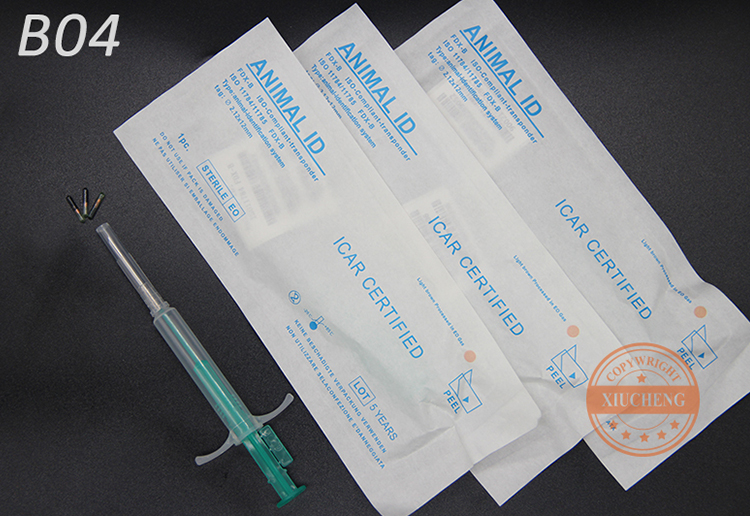
Most dog microchips comply with ISO 11784 / ISO 11785, which define:
- Data structure (15-digit unique ID)
- Air interface protocol
- Operating frequency (134.2 kHz LF)
Common protocols include:
- FDX-B (Full Duplex B) – the global standard
- HDX (Half Duplex) – still used in some regions
- Learn more: FDX-B vs. HDX: Which Animal RFID Tags Should You Choose?
FDX-B is preferred because it offers:
- Faster read speed
- Better multi-vendor compatibility
- Lower interference risk
How RFID Dog Identification Actually Works (Step by Step)
1. Microchip Implantation
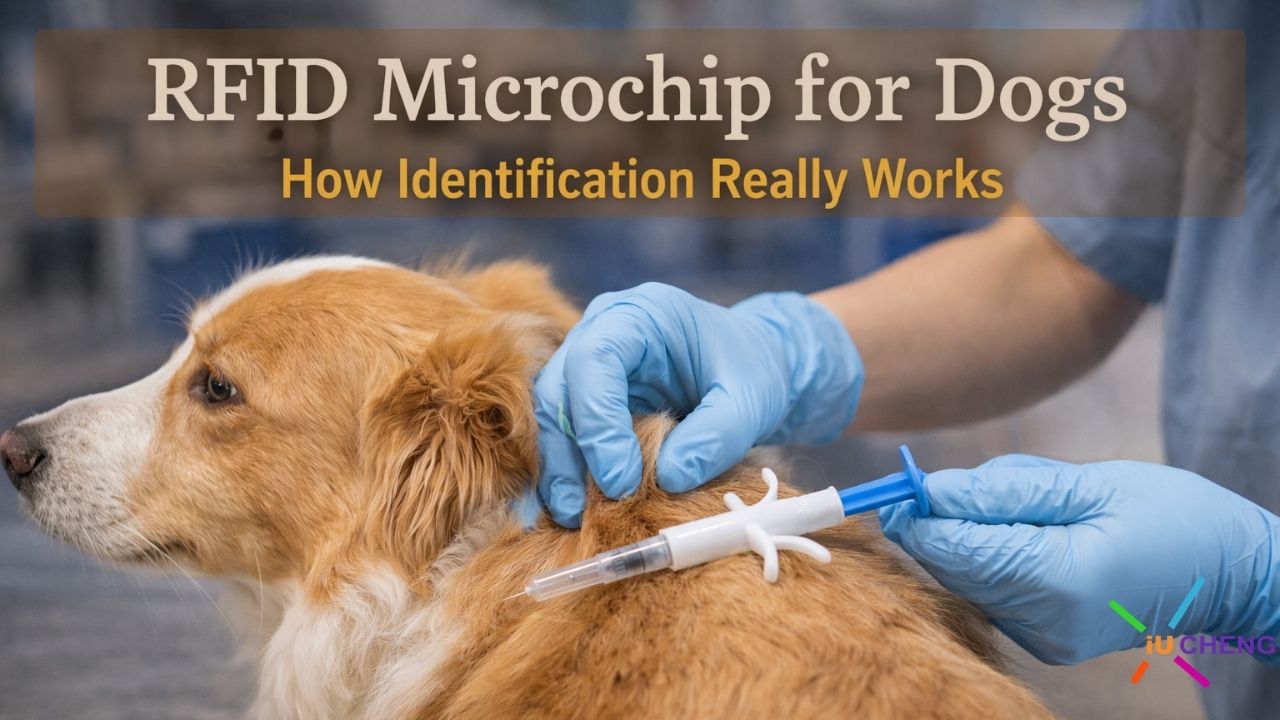
A veterinarian injects the RFID microchip using a sterile syringe.
The procedure is comparable to a routine vaccination and requires no anesthesia.
Once implanted, the chip remains inert until scanned.
2. RFID Scanner Activation
An animal control officer, vet, or shelter uses a handheld LF RFID reader.
The reader emits a low-frequency electromagnetic field at 134.2 kHz.
3. Passive RFID Energy Transfer
When the reader is close (typically within 5–15 cm):
- The microchip’s antenna coil inductively couples with the reader field
- The chip harvests energy (no battery required)
- The IC powers on momentarily
This is classic passive RFID inductive coupling.
4. ID Transmission
The chip transmits its unique 15-digit ID number (UID) back to the reader using load modulation.
Important:
The chip transmits only an ID number, not:
- Owner name
- Address
- GPS location
- Medical records
5. Database Lookup
The scanned ID is entered into a pet recovery database.
If the owner has registered the chip:
- Contact information appears
- The dog can be reunited with its owner
If not registered, the chip is technically readable—but functionally useless.
What an RFID Dog Microchip Is Not
A common source of confusion (and misinformation):
| Myth | Reality |
|---|---|
| It tracks dog location | ❌ No GPS |
| It broadcasts signals | ❌ Passive only |
| It stores owner data | ❌ ID number only |
| It enables real-time tracking | ❌ Requires close-range scan |
RFID microchips are identification tools, not tracking devices.
Why Low-Frequency RFID Is Used (Not NFC or UHF)
From an engineering perspective, LF RFID is chosen because it:
- Penetrates animal tissue reliably
- Is orientation-insensitive
- Has stable performance near water and metal
- Meets global animal ID regulations
Technologies not used for dog microchips:
- NFC (13.56 MHz): too short-range, consumer-oriented
- UHF RFID (860–960 MHz): poor performance in biological tissue
How Long Do Dog RFID Microchips Last?
Because there is no battery, lifespan is theoretically:
- 20+ years
- Often outlasting the animal’s lifetime
Failure rates are extremely low when manufactured to ISO standards.
Safety and Biocompatibility
Certified RFID dog microchips are:
- Encapsulated in medical-grade bioglass
- Anti-allergenic
- Anti-corrosive
- Approved by veterinary authorities worldwide
They do not emit radiation, and scanning exposure is negligible.
Why Registration Matters More Than the Chip Itself
From an identification system perspective:
RFID chip + no database registration = broken system
Best practices:
- Register immediately after implantation
- Keep contact info updated
- Use databases recognized by shelters and vets in your region
RFID Microchips vs. Smart Pet Devices
| Feature | RFID Microchip | Smart Collar |
|---|---|---|
| Power source | Passive | Battery |
| Lifespan | Decades | Months |
| Tracking | No | Yes |
| Removal risk | Extremely low | High |
| Global standard | Yes | No |
In practice, RFID microchips and smart collars complement, not replace, each other.
Final Thoughts: How Dog Identification Really Works
RFID microchips for dogs are simple, robust, and highly reliable because they focus on one task only: permanent identity.
Their effectiveness depends on:
- ISO-compliant LF RFID technology
- Universal reader compatibility
- Proper database registration
Understanding the actual RFID mechanics helps pet owners, veterinarians, and animal welfare organizations make informed decisions—without falling for marketing myths.