


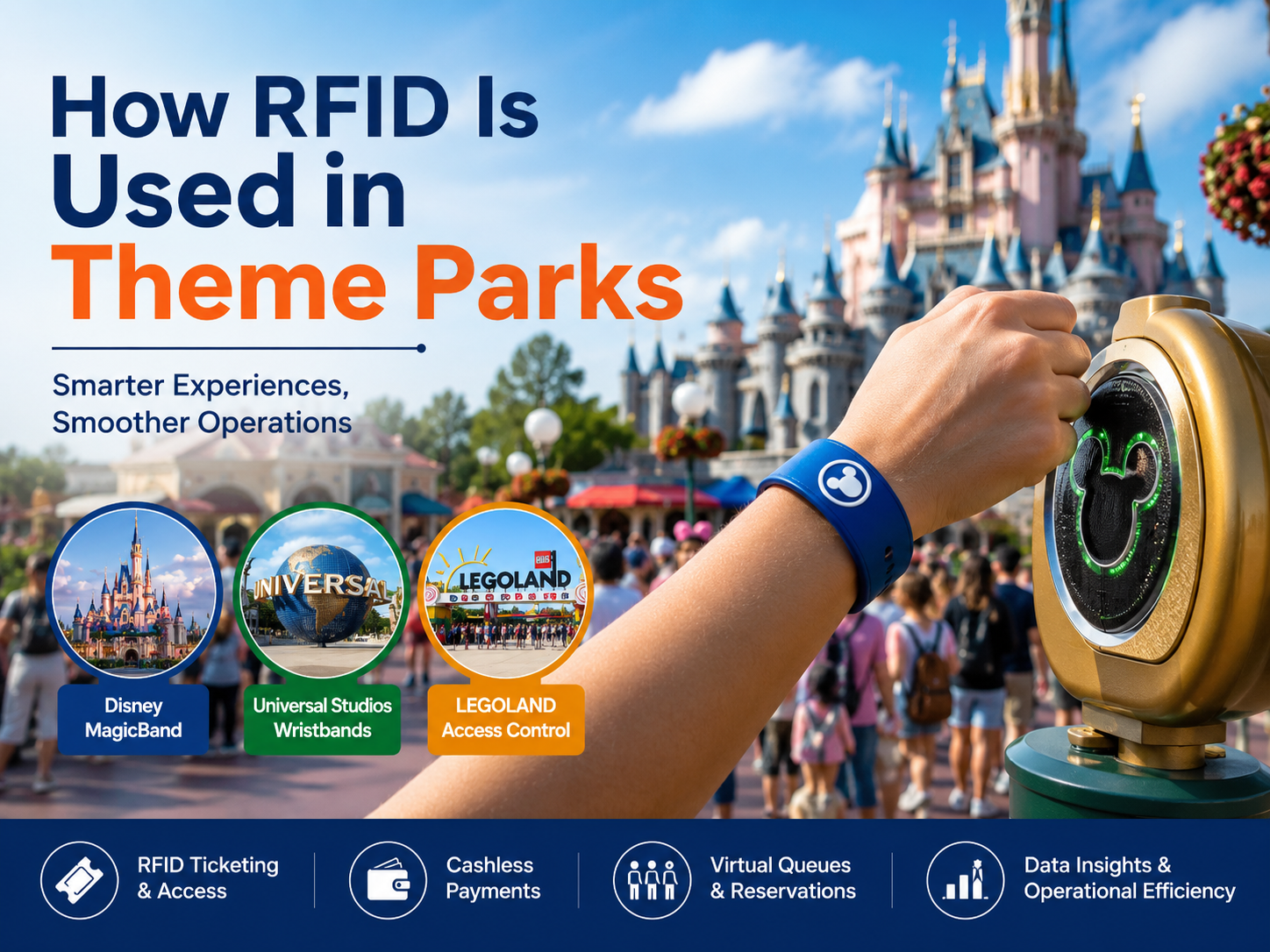
Theme parks are no longer just physical entertainment venues. Modern parks operate as highly connected digital ecosystems where guest identity, payments, ride access, queue management, hotel services, and visitor analytics are integrated into a seamless experience.
RFID technology plays a central role in this transformation.
From wearable wristbands and smart tickets to cashless payments and real-time visitor tracking, RFID has become one of the most important technologies powering large-scale amusement parks worldwide.
In this article, we explore how RFID is used in theme parks through real-world examples including Disney MagicBand, Universal Studios wearable wristbands, and LEGOLAND access control systems.
Why Theme Parks Use RFID Technology
Theme parks face several operational challenges:
- Long visitor queues
- Ticket fraud
- High staffing requirements
- Cash handling inefficiencies
- Lost hotel room keys
- Difficult crowd management
- Limited visitor behavior analytics
- Poor guest personalization
RFID solves many of these issues by enabling contactless identification and real-time data interaction.
Unlike traditional barcode tickets, RFID tags do not require direct line-of-sight scanning. Guests can simply tap or wave their wristband or card near a reader.
This creates a faster, more convenient experience while giving park operators access to valuable operational data.
Common RFID Applications in Theme Parks
1. Ticketing and Park Entry
RFID wristbands or cards can store:
- Ticket information
- Guest identity
- Reservation details
- Access permissions
- Expiration dates
At park entrances, RFID readers instantly validate visitors.
Benefits include:
- Faster entry speed
- Reduced counterfeit tickets
- Lower staffing costs
- Improved visitor flow
- Better security monitoring
2. Cashless Payments
Many theme parks link RFID wristbands directly to payment systems.
Guests can:
- Buy food and drinks
- Purchase merchandise
- Rent lockers
- Pay for premium experiences
- Upgrade tickets
This creates a frictionless purchasing process and increases visitor spending.
Studies across entertainment venues consistently show that cashless wearable systems encourage higher average transaction values because purchases become faster and psychologically easier.
3. Ride Access and Queue Management
RFID helps parks manage ride reservations and virtual queues.
Instead of standing in line for hours, guests can:
- Reserve ride times
- Join virtual queues
- Receive ride notifications
- Access premium fast-pass services
This improves overall visitor satisfaction while reducing visible congestion inside the park.
4. Hotel and Resort Integration
Large destination parks often operate hotels and resorts.
RFID wristbands can function as:
- Hotel room keys
- Resort access credentials
- Pool access passes
- Parking credentials
- Dining plan identifiers
This eliminates the need for guests to carry multiple cards or documents.
5. Visitor Tracking and Analytics
RFID generates massive amounts of behavioral data.
Park operators can analyze:
- Ride popularity
- Peak congestion areas
- Guest movement patterns
- Spending behavior
- Average queue times
- Attraction engagement
This data helps optimize:
- Staffing
- Ride operations
- Park layout planning
- Marketing campaigns
- Food inventory management
- Security response
Recommended RFID Wristbands for Theme Parks
XIUCHENG RFID manufactures durable RFID wristbands and NFC wearables for theme parks, water parks, resorts, and entertainment venues. Our solutions support access control, cashless payments, guest identification, and smart visitor management.
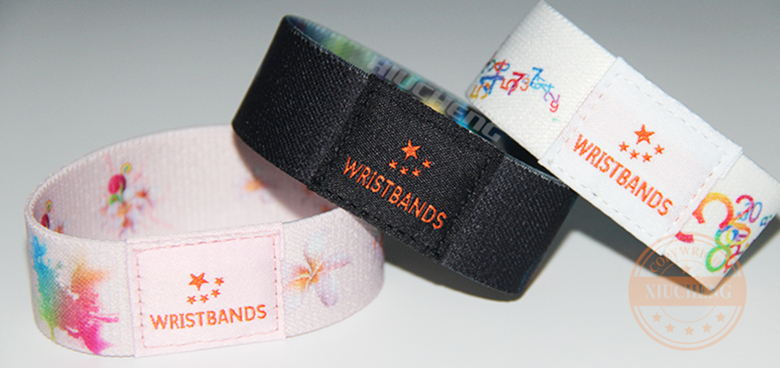
RFID Elastic Wristbands
Comfortable reusable RFID wristbands designed for theme parks, resorts, VIP guest management, and multi-day entertainment experiences.
- Comfortable all-day wearing
- Ideal for resort & VIP access
- Supports NFC & RFID chips
- Custom logo & branding available

RFID Fabric Wristbands
Premium woven RFID wristbands widely used in amusement parks, water parks, family entertainment centers, and branded guest experiences.
- Premium woven appearance
- Excellent anti-counterfeit security
- Perfect for season passes
- Full-color customization available

RFID Tyvek Wristbands
Cost-effective disposable RFID wristbands for daily park admission, special events, water parks, and high-volume visitor management.
- Disposable & lightweight
- Fast RFID ticket validation
- Ideal for large visitor volumes
- Low-cost event deployment
Case Study 1: Disney MagicBand
One of the most famous RFID deployments in the entertainment industry is Disney MagicBand.
Disney introduced MagicBand as part of its “MyMagic+” ecosystem across Walt Disney World Resorts.
The system transformed how visitors interacted with the park.
What Is MagicBand?
MagicBand is an RFID-enabled wearable wristband that combines:
- RFID technology
- Mobile app integration
- Cloud-based guest management
- Payment functionality
- Hotel services
The wearable contains both:
- HF/NFC RFID components
- Long-range RFID capabilities
This hybrid architecture allows both close-range secure interactions and longer-range location-based experiences.
Functions of Disney MagicBand
Guests can use MagicBand to:
Enter Theme Parks
Visitors tap the wristband at RFID-enabled gates for fast admission.
Unlock Hotel Rooms
The same wristband acts as a digital hotel room key.
Access FastPass and Ride Reservations
Guests can reserve attractions and access rides using RFID validation.
Make Cashless Payments
Food, merchandise, and services can be charged directly to the visitor account.
Link Photo Experiences
Ride photos and character photos are automatically associated with guest accounts.
Enable Personalized Interactions
Certain attractions and interactive installations recognize returning guests.
Operational Impact of MagicBand
Disney reportedly invested over one billion dollars into the MyMagic+ initiative.
The investment produced several operational advantages:
Faster Guest Throughput
RFID reduced entry bottlenecks and transaction times.
Increased Revenue
Cashless payments encouraged more spontaneous purchases.
Better Data Collection
Disney gained unprecedented visibility into guest behavior.
Enhanced Customer Experience
Guests spent less time handling tickets, wallets, and reservations.
Stronger Brand Differentiation
MagicBand became part of the Disney experience itself.
Technical RFID Architecture Behind MagicBand
Disney’s ecosystem demonstrates how multiple RFID layers can work together.
HF RFID / NFC
Used for:
- Secure authentication
- Payments
- Entry validation
- Ride access
Typical frequency:
- 13.56 MHz
Long-Range RFID
Used for:
- Presence detection
- Location awareness
- Experience personalization
This allows attractions to detect nearby visitors without requiring direct interaction.
Case Study 2: Universal Studios RFID Wristbands
Universal Studios has also adopted RFID-enabled wearable technology to improve guest experiences.
While implementations vary between locations and attractions, wearable systems are commonly used for:
- Express access
- Interactive attractions
- Guest identification
- Cashless experiences
- Event access control
Volcano Bay TapuTapu Wearable System
One of Universal’s best-known RFID systems is the TapuTapu wearable at Volcano Bay.
Instead of physical waiting lines, guests use wearable devices to reserve attractions virtually.
How TapuTapu Works
Visitors tap wearable devices at ride stations.
The system then:
- Assigns a virtual queue position
- Calculates waiting times
- Sends ride notifications
- Enables ride access when ready
This “queue-less” experience significantly changes visitor flow management.
Benefits for Universal Studios
Reduced Physical Congestion
Guests spend less time standing in queues.
Increased Spending Opportunities
Visitors can shop, eat, or explore while waiting virtually.
Better Crowd Distribution
RFID analytics help balance attraction demand.
Improved Guest Satisfaction
The park experience feels less stressful and more immersive.
RFID and Interactive Experiences
Universal and other modern theme parks increasingly integrate RFID into gamified attractions.
Examples include:
- Interactive wands
- Smart wristbands
- Character recognition systems
- Personalized digital experiences
- Gamification checkpoints
RFID helps create immersive environments where physical actions trigger digital responses.
This is particularly important for family entertainment and children-focused attractions.
Case Study 3: LEGOLAND RFID Access Control
LEGOLAND parks use RFID primarily for:
- Access control
- Child safety
- Ticket management
- Hotel integration
- Guest tracking
Compared with Disney’s highly complex ecosystem, LEGOLAND implementations are often more operationally focused.
RFID Access Control in LEGOLAND
RFID-enabled wristbands and cards help manage:
- Entry gates
- Restricted areas
- VIP experiences
- Resort access
- Child identification
The technology enables quick authentication while minimizing manual ticket inspections.
Child Safety Applications
Family-oriented parks place significant emphasis on child safety.
RFID can help:
- Link children with guardians
- Identify lost children
- Control authorized pickups
- Monitor access permissions
In some implementations, wearable RFID devices assist staff in quickly verifying guest identity.
Why RFID Wristbands Are Ideal for Theme Parks
RFID wristbands are now the preferred form factor for entertainment venues.
Advantages of RFID Wristbands
Waterproof
Essential for water parks and outdoor attractions.
Durable
Can survive long operational hours and heavy usage.
Comfortable
Visitors can wear them throughout the day.
Difficult to Transfer
Helps reduce ticket sharing fraud.
Large Branding Area
Supports custom colors, logos, and promotional printing.
Multi-Function Integration
One device can combine:
- Ticketing
- Payments
- Hotel access
- Ride reservations
- Loyalty systems
- Event access
Common RFID Technologies Used in Theme Parks
HF RFID (13.56 MHz)
Common standards:
- ISO14443
- ISO15693
- NFC
- MIFARE
Typical applications:
- Ticketing
- Access control
- Payments
- Authentication
UHF RFID
Typical applications:
- Asset tracking
- Laundry management
- Equipment management
- Long-range identification
Some parks use UHF RFID backstage for operational logistics rather than guest-facing systems.
RFID Challenges in Theme Park Environments
Despite its advantages, RFID deployment in entertainment venues involves several challenges.
Privacy Concerns
Visitor tracking raises data privacy questions.
Operators must comply with privacy regulations and clearly communicate data usage policies.
Infrastructure Cost
Large-scale RFID deployments require:
- Readers
- Antennas
- Software platforms
- Network infrastructure
- Cloud integration
- Security systems
Initial investment costs can be substantial.
System Integration Complexity
RFID systems must integrate with:
- POS systems
- Hotel software
- Mobile apps
- Ticketing platforms
- CRM databases
- Security systems
Integration complexity increases significantly at enterprise scale.
Durability Requirements
Theme park wearables must withstand:
- Water exposure
- Heat
- UV exposure
- Mechanical stress
- Long operating hours
Industrial-grade RFID wristbands are required for reliable performance.
Future Trends of RFID in Theme Parks
RFID technology in entertainment venues continues evolving.
Future developments may include:
AI-Driven Personalization
RFID data combined with AI can create highly personalized experiences.
Deeper Mobile Integration
Smartphones and wearable RFID systems will increasingly operate together.
Real-Time Crowd Intelligence
Advanced analytics may help parks dynamically optimize crowd distribution.
Smart Interactive Attractions
RFID will continue merging physical and digital entertainment experiences.
Expanded Cashless Ecosystems
Completely wallet-free visitor experiences are becoming more common.

About XIUCHENG RFID
XIUCHENG RFID specializes in manufacturing a wide range of RFID products, including RFID Silicone Wristbands, Tyvek Wristbands, Fabric Wristbands, Elastic Wristbands, Vinyl Wristbands, RFID Laundry Tags, Animal Tags, and RFID Cards. All products are produced under strict quality control and advanced production technology.
With 12 years of experience in wristband design, tag design, quality management, and customer relationship management, we have built a solid foundation for delivering reliable and high-performance RFID solutions.
Conclusion
RFID technology has fundamentally changed how modern theme parks operate.
From Disney MagicBand and Universal Studios virtual queue systems to LEGOLAND access control applications, RFID improves:
- Operational efficiency
- Guest convenience
- Security
- Revenue generation
- Data analytics
- Visitor personalization
As theme parks become increasingly digital and experience-focused, RFID will remain a core infrastructure technology behind smart entertainment ecosystems.
For RFID manufacturers and solution providers, the entertainment industry represents a major growth opportunity for:
- RFID wristbands
- NFC wearables
- Access control systems
- Cashless payment infrastructure
- Visitor analytics platforms
- Smart venue management
The future of theme park experiences will likely become even more connected, immersive, and data-driven — with RFID continuing to power the interaction between visitors and intelligent entertainment environments.


